I have written a book together with Google
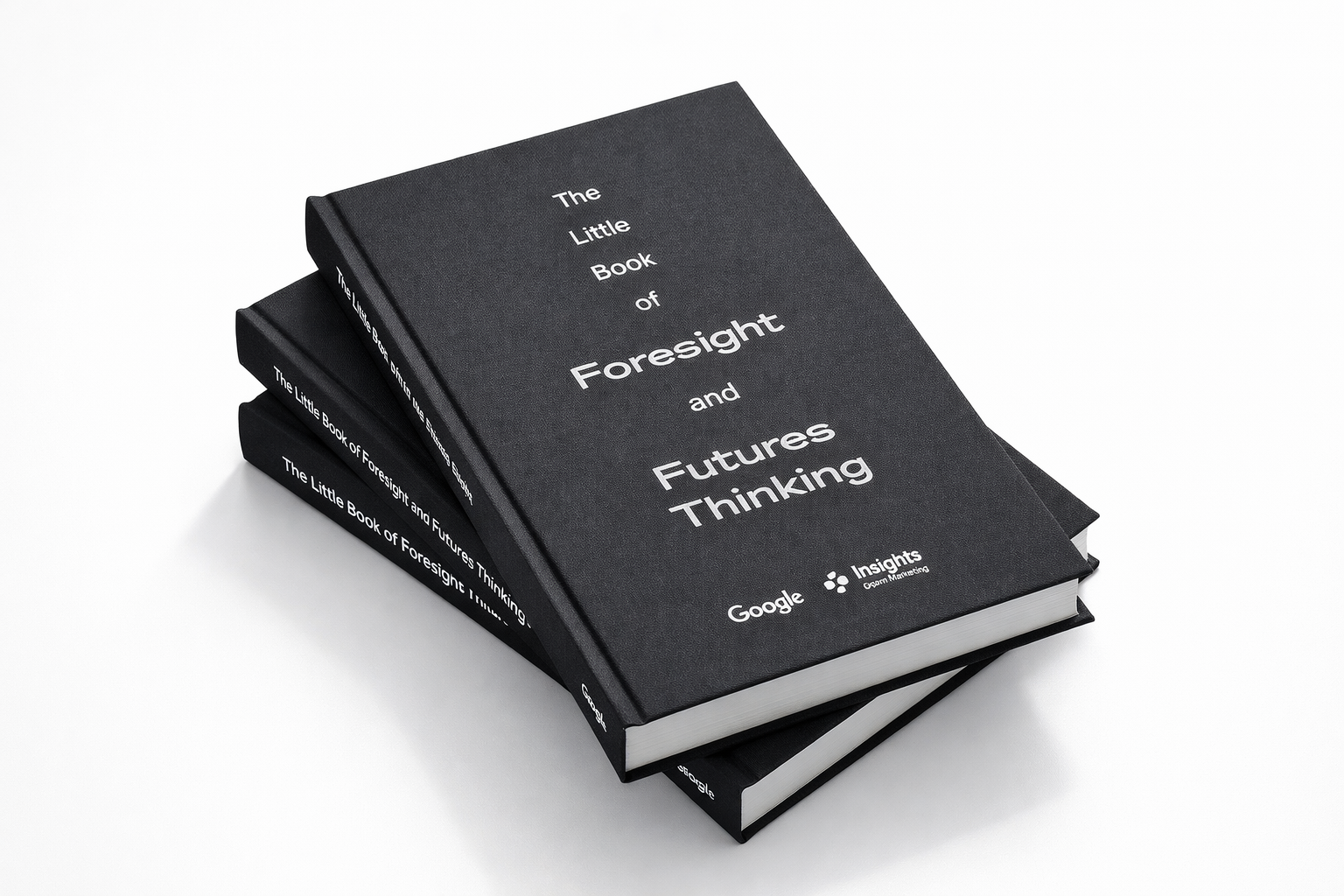
I have written a book in collaboration with Google Insights Academy. For the people at Google.
It still feels a little strange to write. Not because it's a big milestone, but because it made me stop and think about how long this thread has actually been part of my work.
My work with foresight and the future did not start out as something particularly structured. It began much earlier, and in a much more messy, curious, and open way.
One of the first projects I was involved in at the Kaospilot program was linked to LEGO's foresight lab. We were students—young, optimistic, and certainly a little naive—and were thrown into exploring the future of children and play.
What stayed with me from that experience was not only the frameworks and methods we were introduced to, but also the way of working with the future. When we really tried to understand what was already happening—signals, behaviors, small cultural movements—some pretty clear directions began to emerge. Some of the ideas we worked with back then later resembled products that LEGO launched several years later. Not because we were particularly brilliant, but because that's what good foresight can do.
It stuck with me. A kind of structured curiosity. Working across disciplines. Accepting that there is no one right answer. And practicing asking better questions.
Later, I became deeply involved in designing and facilitating programs at Hyper Island. These were often targeted at organizations in the midst of digital transformation, but in reality, they were spaces where leaders and teams could take a step back and think more fundamentally about the future of their business, their customers, and their culture.
My role was to design the learning experiences and facilitate the conversations. To create space for reflection, dialogue, and challenging the assumptions that are otherwise taken for granted in a busy everyday life. And just as importantly: to help translate this into something concrete—decisions, experiments, and new ways of working.
At the time, I probably wouldn't have called it foresight in the classical sense. It was less structured and less theoretical. But looking back, that's exactly what it was—just in a more human and action-oriented form.
In recent years, this has become more apparent and more disciplined. Through collaboration with the Copenhagen Institute for Futures Studies and work with Hyper Island's foresight and futures courses, I have had the opportunity to delve deeper into more structured ways of working with the future.
But with my background in leadership development, organizational development, and learning design, I have probably always been less concerned with predicting the future—and more concerned with getting people to actually work with it.
I have never really seen myself as a futurist. I don't write trend reports or lists of "the 10 most important trends." I am more interested in what happens when people are given the opportunity to explore, ask questions, and work with uncertainty in their everyday lives.
Taking something that feels complex and overwhelming and making it possible to work with. Not by simplifying it, but by making it useful.
So when Google reached out to Hyper Island with a question—how they could get their Insights community to work more actively with a larger foresight report—it made perfect sense.
They didn't want to turn people into foresight experts. They were already talented individuals. They just needed a way to work with the future in the midst of their busy everyday lives. A way to think a little more openly and a little more long-term, without it becoming yet another cumbersome process.
We designed a program for around 60 people across Google's global Insights community. We took their existing foresight work as our starting point, but made it more experience-based. Participants worked with future narratives and scenarios, explored what this could mean for their work, and linked it to concrete opportunities and actions.
It became less something you had to understand and more something you could actually work with.
Ultimately, it made sense to compile it into a publication. Partly to make it available to others internally, and partly to give participants something to return to – a way to hold on to the ideas after the course.
And that's the book.
Looking ahead, it seems that the work will continue. We are in the process of figuring out how foresight can become something that lives within the organization—not just as reports or projects, but as part of the way people think and make decisions.
I have become more interested in how foresight can move out of the boardroom or innovation department and into the organization more broadly. Not as something abstract, but as something people actually use in their work.
This could be in specific teams close to the business, or in cross-functional communities where we work together to understand and address the challenges ahead.
I'm not entirely sure where it will end up, but it feels like a continuation of something that started a long time ago—just in a slightly more obvious form. What I do know is that we will continue working with Google and finding new ways to bring foresight to life – probably in ways I haven't seen or heard others do before. I hope to be able to share more along the way.